
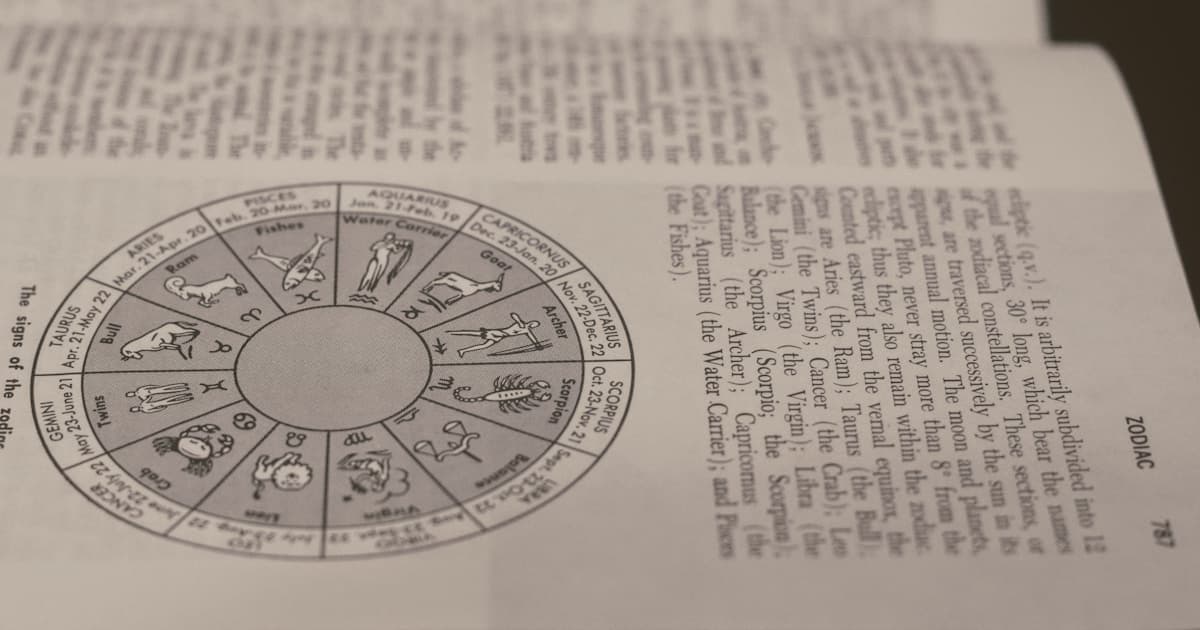
Reading a birth chart for the first time can feel like staring at a foreign language. Symbols, lines, numbers, and colored arcs overlap in a circular diagram that seems impenetrable to anyone who has not studied it. But the underlying logic is simpler than it looks. Every birth chart is built on three layers: planets (what), signs (how), and houses (where). Once you understand how those three layers interact, you can read any chart.
Step 1: Identify the Big Three
Before diving into the full chart, find your three most important placements: your Sun sign, Moon sign, and Rising sign. These three form the foundation of your personality.
Your Sun sign is your core identity — your ego, purpose, and the qualities you are developing throughout life. Your Moon sign is your emotional core — what you need to feel safe, how you process feelings, and your instinctive reactions. Your Rising sign is your outer personality — the impression you make on strangers and the lens through which you experience the world.
Together, these three placements describe about sixty percent of your personality. If someone asks you to summarize your chart in one sentence, your Big Three is the answer.
Step 2: Look at Your Personal Planets
After the Big Three, examine the positions of Mercury, Venus, and Mars. These personal planets move relatively quickly and describe the specific textures of your daily personality.
Mercury reveals how you think and communicate. Mercury in Gemini produces a rapid, curious mind that juggles multiple conversations simultaneously. Mercury in Taurus thinks slowly and deliberately, preferring depth over speed. Where Mercury sits by house shows the life area where your intellectual energy is most focused.
Venus shows what you love and how you love. Venus in Scorpio craves intensity and emotional depth in relationships. Venus in Aquarius values intellectual stimulation and independence. The house position reveals where you seek beauty, pleasure, and connection.
Mars shows your drive and ambition style. Mars in Capricorn is strategic and relentless in pursuing goals. Mars in Pisces acts on instinct and fights for ideals rather than personal gain. The house position shows which area of life receives your most forceful energy.
Step 3: Check Your Outer Planets
Jupiter, Saturn, Uranus, Neptune, and Pluto move slowly enough that entire generations share the same sign placement. Their house positions, however, are individual to you.
Jupiter in your chart shows where expansion, luck, and opportunity naturally flow. Saturn shows where you face your hardest lessons and build lasting structure. Uranus reveals where you experience disruption and innovation. Neptune shows where you dream, imagine, and sometimes deceive yourself. Pluto indicates where you undergo the deepest psychological transformation.
Pay special attention to Saturn — it often reveals the area of life where you feel the most pressure but also where you can build your greatest achievements.
Step 4: Examine Your Houses
Look at which houses contain the most planets. Clusters of planets in a particular house (called a stellium when three or more planets share a house) indicate that area of life is a major focus.
A stellium in the Tenth House suggests a person whose life revolves around career and public achievement. A stellium in the Fourth House points to someone whose home, family, and emotional roots are the dominant life theme. A stellium in the Seventh House indicates relationships are the central arena where personal growth occurs.
Also note which houses are empty. Empty houses are normal and do not mean those areas are inactive. They simply operate with less planetary emphasis.
Step 5: Identify the Major Aspects
Aspects are the angles between planets, and they describe how different parts of your personality interact. Most chart software highlights aspects with colored lines connecting the planets.
Look for conjunctions first — planets that sit right next to each other, within a few degrees. Conjunctions create the most intense energy because two planetary forces merge. A Venus-Mars conjunction blends attraction and desire into a powerful romantic and creative drive.
Next, notice squares — planets ninety degrees apart. Squares create friction that demands action. A Moon-Saturn square often indicates emotional restriction in childhood that builds deep resilience over time. Trines — planets one hundred twenty degrees apart — create ease and natural talent but can also create laziness if you never have to work for those gifts.
Step 6: Read the Chart as a Story
The final step is the most important: read the chart as a coherent narrative rather than a list of isolated facts. A birth chart is not a collection of traits — it is a story about a person.
Look at the overall shape. Are the planets spread evenly around the chart, or are they clustered on one side? A chart with all planets above the horizon tends toward public life. A chart with planets below the horizon emphasizes private, inner work.
Notice the dominant element. Count how many planets fall in fire signs (Aries, Leo, Sagittarius), earth signs (Taurus, Virgo, Capricorn), air signs (Gemini, Libra, Aquarius), and water signs (Cancer, Scorpio, Pisces). The element with the most placements reveals your dominant mode of experiencing the world.
Reading a chart well takes practice. Start with your own chart, learn to recognize the patterns, and then try reading charts for people you know well. Over time, the symbols stop being abstract and start telling vivid, recognizable stories.